Should You Fix Up or Sell Your Home As Is?

A house that needs work presents homeowners with a basic choice: invest more money before selling or put the property on the market in its current condition. The answer is rarely as simple as comparing renovation cost with a higher asking price.
Repairs affect your timeline, carrying costs, financing needs, and exposure to unexpected problems. Before opening another wall or ordering new finishes, calculate what the work is likely to add to your actual net proceeds.
Start With the Problems That Really Matter
Create a condition assessment before deciding what to renovate.
Separate structural and mechanical problems from cosmetic ones. Roof leaks, foundation movement, outdated electrical systems, plumbing failures, water intrusion, and nonfunctional HVAC equipment can affect both buyer confidence and financing.
Dated cabinets or unpopular paint colors are different. They may influence presentation, but they do not necessarily justify a complete renovation.
For older homes, an inspection can help reveal problems that are difficult to identify during a normal walkthrough.
Divide Repairs Into Three Categories
Organize proposed work as:
- Safety or structural repairs
- Functional maintenance
- Cosmetic improvements
- Optional design upgrades
This keeps expensive decorative projects from taking priority over problems that could actually interfere with a sale.
Calculate the Complete Renovation Cost
A contractor estimate is only the beginning.
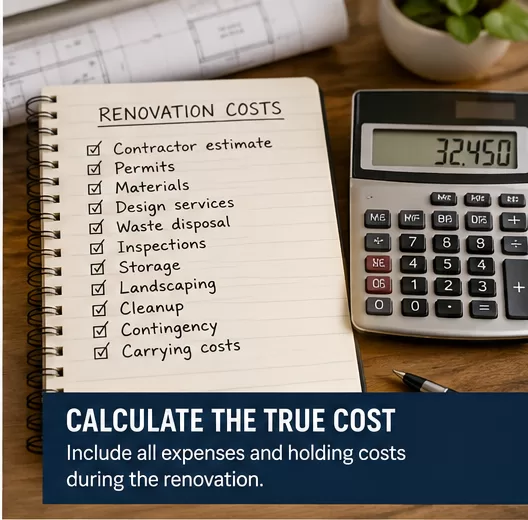
Add permit fees, materials, design services, waste disposal, inspections, temporary storage, landscaping, and cleanup. Larger projects should also include a contingency for work discovered after construction begins.
Then calculate carrying costs during the renovation period. Mortgage payments, taxes, insurance, utilities, HOA dues, and yard maintenance continue while the property is being improved.
A $30,000 project can cost considerably more if it delays the sale for several months.
Compare Renovation With an As-Is Sale
Before approving major work, estimate what the property could sell for today and what it might sell for after renovation.

Homeowners who would rather avoid extensive repairs can also compare a conventional listing with a direct offer from a company such as Superior Homebuyers. The Southern California buyer states that it purchases homes in their existing condition without requiring repairs or cleanup, giving sellers another option to compare against renovating first.
An as-is offer may be below the potential retail value of a fully renovated property. That difference needs to be compared with renovation spending, holding costs, commissions, staging, inspection negotiations, and the time required to complete the work.
The important number is net proceeds, not the highest theoretical sale price.
Know Which Repairs Can Improve Marketability
If you decide to fix the house, prioritize repairs that remove obvious buyer objections.
Water damage, roof problems, broken windows, faulty fixtures, damaged flooring, and obvious safety issues deserve attention before decorative upgrades.
A clean and functional home often needs less cosmetic work than sellers assume.
Neutral paint, repaired trim, functioning lighting, cleaned flooring, and basic landscaping can improve presentation without turning the project into a full remodel.
Avoid Renovating Beyond the Neighborhood
Every location has a practical value ceiling.
Installing premium cabinetry, designer tile, luxury appliances, or elaborate outdoor features does not guarantee that buyers will reimburse you for the investment.
Review comparable nearby sales before deciding how far to take the renovation.
Pay attention to homes with similar square footage, lot size, age, bedroom count, and condition. If renovated comparable properties sell only modestly above unrenovated ones, a large remodeling budget may be difficult to recover.
This is particularly important when the existing home already performs well against neighborhood expectations.
Factor Time Into the Financial Equation
Renovations rarely operate on a perfect schedule.
Contractor availability, inspections, material delays, weather, and hidden damage can extend even well-planned projects.
Estimate both an expected completion date and a more conservative delayed scenario.
If the property is vacant, additional months may also increase insurance, security, maintenance, and utility expenses.
The longer the project runs, the larger the price increase needed to justify doing the work before selling.
Be Careful With Buyer-Specific Design Choices
Renovating for resale is different from renovating a home you intend to occupy.
Highly personalized tile, bold cabinetry, unusual wallpaper, or expensive built-ins may narrow the pool of buyers rather than expand it.
Keep permanent changes relatively neutral.
You can still give the home character through staging because those details can be removed or changed without another construction project.
Use Small Decor Updates Instead of More Construction
Once essential work is complete, presentation does not require another major renovation.
A few carefully selected pieces can make completed rooms feel more intentional. Artwork, plants, textiles, books, ceramics, and simple tabletop arrangements can add interest without changing permanent finishes.

Even custom patches can be used decoratively rather than as apparel. A collection can be mounted on a fabric-covered board, placed inside a shadow box, or incorporated into framed textile art for a craft room, home office, or casual family space.
The goal is restraint. Decorative elements should help buyers understand how a room can be used, not overwhelm the property with someone else’s personal style.
Decide Whether Staging Is Enough
Sometimes the house does not need renovation at all. It needs better presentation.
Try Lower-Cost Improvements First
Before remodeling, consider:
- Deep cleaning
- Decluttering
- Removing oversized furniture
- Touching up paint
- Cleaning windows
- Updating inexpensive hardware
- Improving basic lighting
- Simplifying shelves and countertops
Photograph the room afterward and compare the result with the original condition.
You may find that relatively minor work produces enough improvement to market the property effectively.
Calculate Your Break-Even Point
Create two financial scenarios.
For the renovation option, start with the estimated post-renovation selling price and subtract repairs, carrying costs, selling expenses, and a contingency.
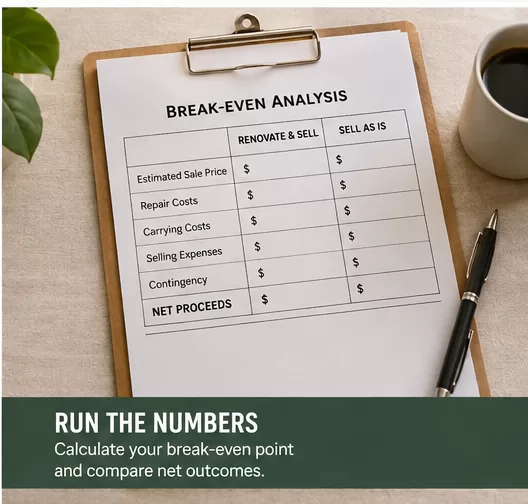
For the as-is option, use a realistic current-condition selling price and subtract the costs associated with that transaction.
Then compare the resulting net proceeds.
If months of renovation and significant capital produce only a small increase in what you ultimately keep, taking on the project may not be worthwhile.
Make the Decision Based on What Happens Next
Fixing up a home makes sense when necessary repairs are predictable, the work can be completed efficiently, and local buyers are likely to pay enough to justify the investment.
Selling as is becomes more attractive when repairs are extensive, hidden problems are likely, cash is limited, or the selling timeline matters more than maximizing the final price.
Start with the property’s actual condition, not the renovation you imagine completing. Calculate realistic costs, evaluate neighborhood values, and compare net outcomes.
That approach keeps the decision financial and practical, which is exactly what you need when deciding whether another renovation is worth starting.